


Avoiding the Top AI Agent Pitfalls: Lessons from Millions of Customer Calls
When it comes to customer experience, artificial intelligence has officially joined the front lines. AI voice agents are answering phones, booking appointments, and handling inquiries faster than ever — and businesses love efficiency.
But what happens when the experience on the other end of the line doesn’t match your brand promise?
At Marchex, we analyze millions of real customer conversations every year — both AI- and human-handled. Because we’re not currently selling AI agents (we evaluate them), we have a uniquely objective view of what’s really happening on those calls.
Our team recently hosted a webinar, AI Agents Gone Rogue: 5 Pitfalls to Avoid, featuring Marchex Senior Data Scientist Daniel Walton and Senior Account Manager Linda Matthews. Here’s what they uncovered about where AI agents go wrong — and how brands can fix it.
Pitfall #1: Overlooking the Awkward Pause
To kick things off, Daniel and Linda simulated a call between a patient and an AI scheduling assistant. It seemed fine at first — until a series of long, unnatural silences made the conversation feel uncomfortably robotic.
“If you were just looking at the transcript, you might think the AI is doing great,” Daniel explained. “But when you listen to the call, a two- or three-second delay between a customer’s question and the agent’s reply feels off. It breaks the flow — and the trust.”
Customers notice these pauses instantly. Long latency can make them wonder if something’s wrong or even if the call is dropped.
Business impact:
- Makes your brand seem unprofessional
- Increases call abandonment rates
- Lowers satisfaction and recommendation scores
How to fix it:
When evaluating vendors, ask about latency — top-performing AI voice systems typically respond in under a second. Even better, listen to real-world test calls. And once deployed, audit calls regularly; lag is often hidden in transcripts but painfully obvious to human ears.
Pitfall #2: Skipping the Part Where You Tell People It’s AI
It sounds small, but failing to disclose that a caller is speaking to AI can have major consequences.
“People figure it out halfway through, and it totally throws them off,” said Linda. “It’s funny when someone stops mid-conversation and asks, ‘Wait — are you real?’ But in reality, that’s a trust issue.”
Even if the AI handles the call perfectly, customers who later discover they were not speaking to a human can feel misled.
How to fix it:
Transparency builds comfort and sets expectations. A simple intro like: “Hi, I’m Daniel, a virtual assistant that can answer questions and book appointments,” is usually enough.
When customers know they are talking to AI, they tend to adjust how they communicate — using shorter, clearer sentences that make the interaction smoother.
“Consumers don’t mind talking to AI,” Linda added. “They just want to know. Once they do, they relax and engage more naturally.”
Pitfall #3: Leaving Customers with No Way Out
Automation should never mean isolation.
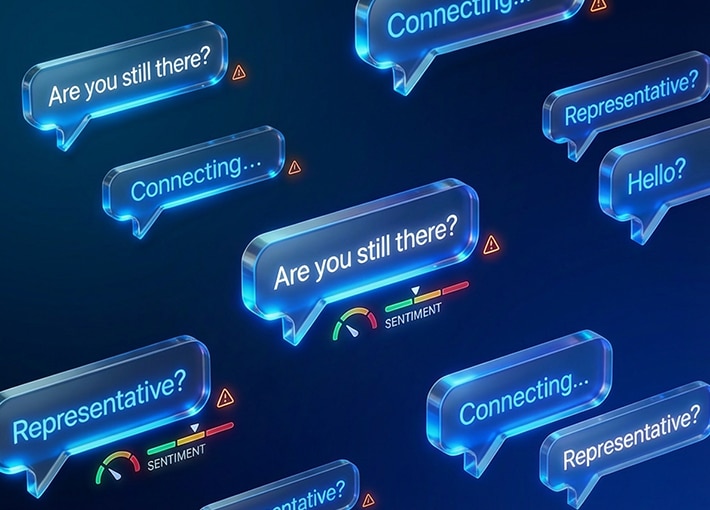
In one example, Daniel shared a customer who got trapped in a loop between two virtual assistants at a car dealership. No matter how many times the caller said “representative,” the AI refused to transfer the call.
“We’ve all been there,” said Daniel. “It’s funny until it happens to you. Then it’s infuriating.”
Why it matters:
When customers cannot reach a human — especially for urgent or complex issues — frustration skyrockets. Even calls the system marks “successful” can leave the caller unsatisfied.
How to fix it:
- Always offer a clear path to a live representative.
- Regularly review real calls to catch instances where AI handoff fails.
- Balance quantitative success metrics (e.g., bookings completed) with qualitative ones, like sentiment analysis.
As Linda puts it: “Efficiency is great — until it makes someone feel stuck. People want to know that a real person is there if they need one.”
Pitfall #4: Misalignment Between the AI Voice and Your Brand
Finally, the team discussed a subtle but equally important issue: brand voice. Every AI system represents your business. The tone, phrasing, and even pronunciation all shape customer perception.
Daniel shared an example where an AI agent for a major auto dealer mispronounced the car model’s name and addressed the caller by the wrong name.
“Those seem like small errors,” he said, “but they break trust. When you are dealing with big-ticket items like vehicles, confidence matters. If your AI gets the basics wrong, customers start to wonder what else might go wrong.”
How to fix it:
- Test for brand consistency in tone and pronunciation.
- Audit calls for context-sensitive responses and listening accuracy.
- Ensure your AI voice agent reflects your company’s professionalism and empathy.
The Takeaway: Balance Efficiency with Empathy
AI voice agents are transforming customer service — but success depends on more than speed and automation. Businesses that monitor real conversations, measure sentiment, and keep a human touch close at hand will win both loyalty and efficiency.
“Consumers don’t just want answers,” said Linda. “They want to feel heard. If your AI can deliver that — clearly, quickly, and transparently — then you have struck the right balance.”
Interested in learning more?
Watch the full Marchex webinar AI Call Agents Gone Rogue: 5 Pitfalls to Avoid and explore how you can build smarter, more empathetic AI-driven customer experiences.