


The New Reality of Auto Service Operations: Why Ignoring Customer Conversations Is Limiting Performance
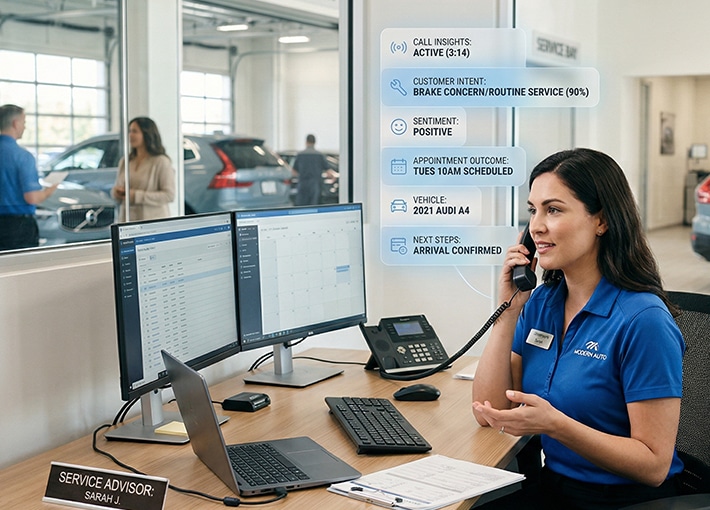
Auto service leaders are under pressure to do more with less, optimize technician capacity, grow revenue per RO, and protect margins in an increasingly competitive market. At the same time, customer expectations are being shaped by frictionless, digital-first experiences in every other part of their lives.
The disconnect? Most operations leaders still rely on lagging indicators and partial data to understand what’s really driving appointment volume, approvals, and lost business. The real story is playing out in every phone call and conversation with your shops and service advisors -- and for most organizations, that operational gold is still largely unmined.
Market Landscape: What’s Changing in Auto Service Operations
Across auto service (dealership service lanes, independents, tire and repair chains, specialty and aftermarket) call volume and customer interactions remain high even as digital channels grow. Customers research online, but they still pick up the phone to schedule appointments, discuss repairs, clarify pricing, and decide where to take their vehicles.
Meanwhile, operations teams are being asked to:
- Maximize bay and technician utilization without degrading the customer experience
- Reduce appointment no-shows and abandoned calls that bleed revenue
- Standardize advisor performance across locations and regions
- Respond quickly to shifting demand, marketing campaigns, and capacity constraints
Yet most of the data that COOs rely on—ROs, CSI scores, basic call counts, and disconnected dashboards—says what happened, not why it happened. Structural change is happening at the conversation level: how well locations answer the phone, handle price questions, overcome objections, and convert inbound demand into booked work. This is where today’s most advanced auto service operators are starting to focus.
The Strategic Tension: Why Traditional Approaches No Longer Hold
Traditional operating models treat phone calls and conversations as a cost center, not a performance driver. Leaders invest heavily in marketing to drive inbound demand but have limited visibility into what happens when that demand actually reaches the store or service lane.
Common limitations include:
- Surface-level call reporting: Knowing call volume and duration, but not whether the caller was a new or existing customer, what they wanted, or whether revenue was won or lost.
- Lagging, survey-based feedback: CSI and post-service surveys highlight issues after the fact, with low response rates and no context on specific conversations.
- Manual coaching and spot checks: Random call monitoring and subjective feedback don’t scale across dozens or hundreds of locations.
- Fragmented accountability: Marketing is measured on leads, operations on throughput, and the call experience sits in between with no clear ownership.
- The result is a growing disconnect: leadership teams are held accountable for revenue, efficiency, and customer satisfaction, but the most critical moments affecting those metrics—the live conversations—are largely invisible at scale.
A New Way to Think About Conversation-Driven Performance
Forward-thinking auto service operations leaders are reframing conversations as a core operational dataset, not just a customer touchpoint. Instead of relying only on what gets recorded in the DMS or CRM, they are using conversation intelligence to understand—and improve—how every location handles real customer demand.
This mindset shift looks like:
- Treating every inbound and outbound call as measurable, actionable operational data
- Connecting what customers say and ask for to specific outcomes: booked appointments, declined repairs, lost opportunities, and saved relationships
- Using AI-powered solutions to surface patterns that humans can’t practically review at scale—by location, advisor, campaign, and call type
- Turning subjective “phone skills” into objective, trackable performance metrics tied directly to revenue and CX
Marchex has seen auto service organizations use conversation intelligence to gain visibility into missed opportunities, recover revenue from mishandled calls, and standardize best practices across stores and advisors. Rather than guessing which operational levers to pull, leaders can align staffing, training, and process changes to what is actually happening in real customer conversations.
Leadership Implications: What This Means for Decision-Makers
For COOs and operations leaders, this shift from call counts to conversation intelligence has direct strategic implications:
- Redefine operational KPIs: Move beyond generic call metrics to include conversation outcomes—appointments set, services requested but not booked, high-intent callers who didn’t convert, and reasons for lost business.
- Align marketing and operations: Use shared visibility into conversations to ensure that marketing investments translate into appointments and completed work, not just inbound calls.
- Standardize at scale: Identify what your best-performing locations and advisors do differently on calls and replicate those behaviors across the network with targeted coaching.
- Protect capacity and margins: See where high-value opportunities are being mishandled or missed entirely and adjust staffing and workflows to match real-time demand.
- Strengthen the customer experience: Understand how customers talk about price, timing, and trust—and use that insight to refine scripts, processes, and training in ways that are grounded in reality, not assumptions.
This is not about adding another dashboard, but about making conversations a core, reliable input into how you design, manage, and scale your operations.
Closing Reflection
The auto service leaders who will win the next cycle are those who treat every customer conversation as a measurable, improvable asset. As competitive pressure and customer expectations rise, relying on partial, lagging data is no longer enough to run a high-performing operation.
By elevating conversation intelligence into the core of operational decision-making, COOs can close the gap between what’s happening in the service lane and what shows up in the P&L—turning everyday calls into a durable advantage in efficiency, revenue, and customer loyalty.
Explore how auto service operations leaders are using real customer conversations to guide decisions, close performance gaps, and turn inbound demand into measurable revenue and loyalty. Contact us today.